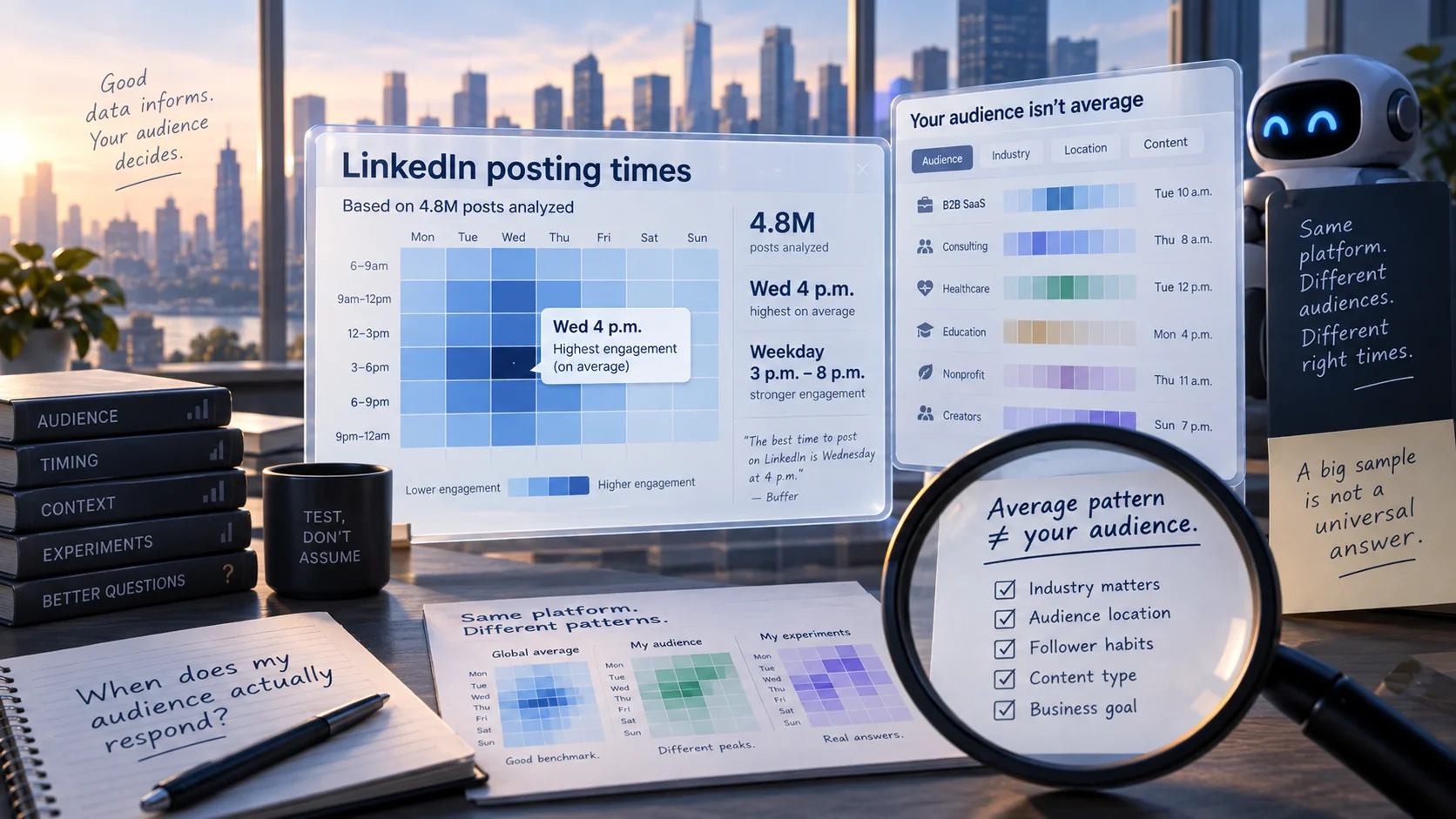
Buffer’s analysis of 4.8 million LinkedIn posts identifies late weekday afternoons and evenings as the strongest engagement window. Wednesday at 4 p.m. ranks first, with Friday at 3 p.m. and 4 p.m. close behind. The times are normalized to local time, and the article recommends using them as a starting point before consulting an account’s own analytics.
That last qualification is important. Buffer does not claim that timing can rescue irrelevant content, and it acknowledges that audiences differ. A dataset this large can provide a useful benchmark, especially for a new account with no history. The apparent move away from morning posting is also worth testing rather than dismissing.
But 4.8 million is a measure of volume, not necessarily relevance. Every post in the dataset was sent through Buffer, which means the sample represents people and organizations using a scheduling platform rather than LinkedIn publishing as a whole. Those users may plan content more deliberately, publish more frequently or differ from native publishers in other ways. Millions of observations cannot remove that selection problem.
The article also provides too little methodological detail to judge the precision of its recommendations. It does not explain how many distinct accounts produced the posts, how heavily the largest publishers influenced the results, how industries and countries were distributed or whether repeated posts from the same account were treated as independent observations. A dataset containing many posts from a comparatively small group of prolific accounts can look broader than it is.
More fundamentally, the analysis defines “best” through engagement. Reactions, comments and reposts are visible and useful, but they are not interchangeable with qualified leads, job applications, newsletter subscriptions, sales conversations or brand recognition. An entertaining creator post and a technical update from a small B2B company can have completely different purposes. Averaging their interactions produces a platform pattern, not a business recommendation.
Posting time is not randomly assigned either. Publishers choose when to release particular formats and topics, often using previous advice about when audiences are active. Important announcements may be reserved for expected peak periods, while routine or automated posts fill weaker slots. Account size, content quality, format and posting frequency can all influence engagement alongside timing. The observed association therefore cannot establish how the same post would have performed at another hour.
Normalizing by local time creates another false simplicity. The publisher’s location may not match the audience’s location, particularly for global companies, remote professional communities and creators with international followings. Four in the afternoon in an account setting is not automatically four in the afternoon for the people expected to respond. A universal local-time recommendation hides the very geographic variation that normalization appears to solve.
The reported change from 2025 also needs caution. A later engagement peak could reflect changing LinkedIn behavior, but it could also come from a different mix of Buffer customers, post formats, regions or platform distribution rules. The article offers plausible explanations about professionals browsing after work while correctly admitting that the data cannot identify the cause. That admission should limit how confidently the pattern is described as a behavioral shift.
The addendum is simple: use the average as a prior, not an appointment. Rotate comparable posts through several plausible windows, separate results by format and audience, and measure the outcome the account actually needs. Buffer’s study can tell publishers where an experiment might begin. Only their own repeated evidence can tell them when their audience is worth reaching.