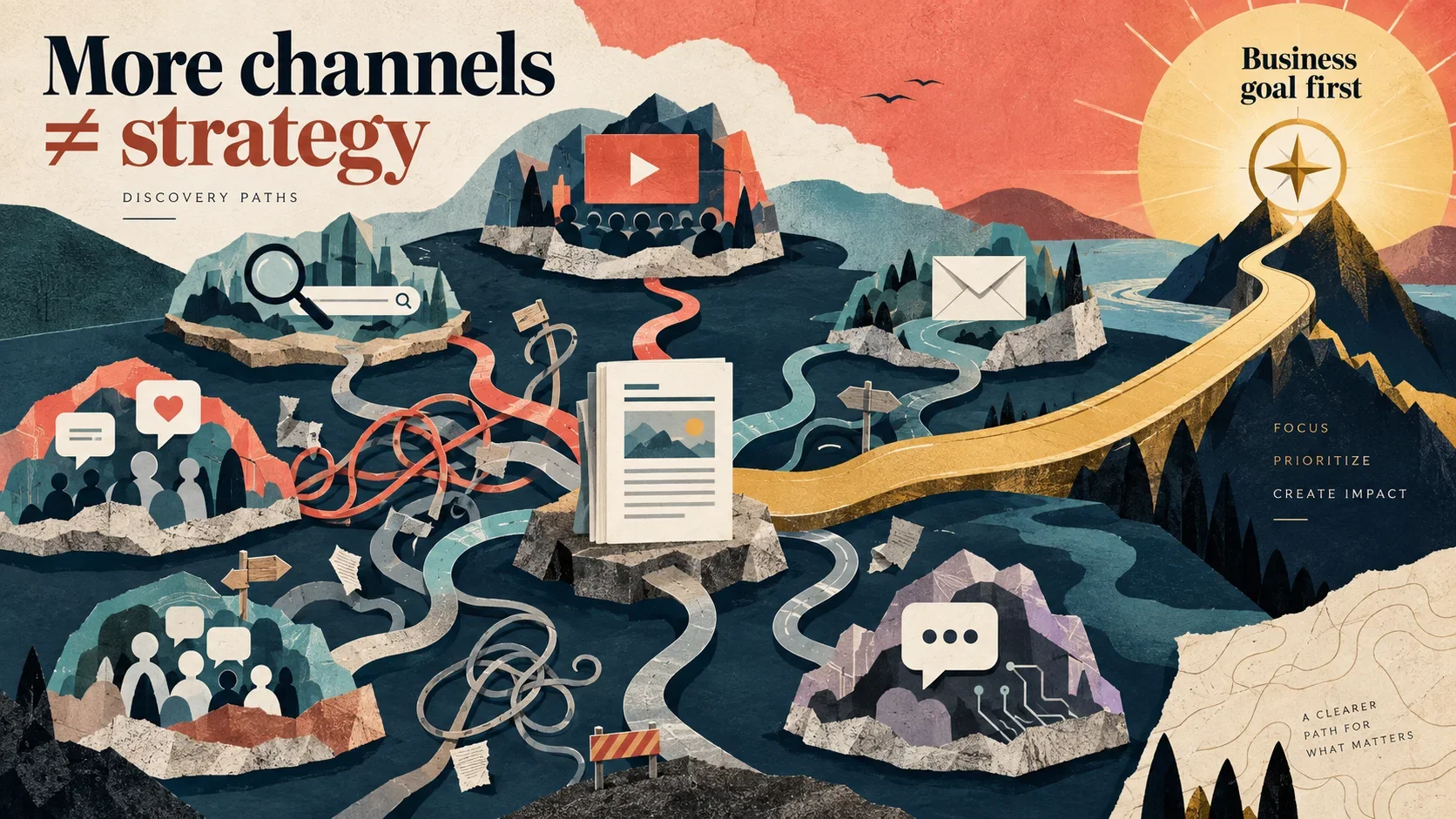
Semrush’s ultimate guide to creating a content marketing strategy argues that companies should stop treating Google rankings as the center of content marketing. It proposes an eight-step process that begins with a business goal and audience research, then moves through channel selection, topic discovery, production, distribution, and measurement. Search, video, social platforms, communities, email, and AI discovery are treated as different routes through which an audience may encounter a company.
That correction is useful. Search traffic is not a strategy, distribution should not be postponed until after publication, and a format should fit both the audience and the team’s actual capabilities. The guide is also right to recommend interviews, sales conversations, support records, reviews, and community discussions alongside platform data. Those inputs are more revealing than a keyword list alone.
Yet the process contains a conspicuous gap between discovering what people ask and deciding what a company can say that is worth hearing. The guide asks who the audience is, where it spends time, which topics show demand, and which formats the team can produce. It does not ask what distinctive knowledge, evidence, experience, or argument the business contributes. That is not a minor creative detail. It is the editorial core of the strategy.
A team can follow every step and produce competent, measurable, multichannel sameness. It can interview users, select a promising topic, write a clear article, turn it into a video and carousel, optimize each version, and track the resulting sign-ups. If competitors can make essentially the same package from the same visible questions and research tools, the company has built a distribution system, not an editorial advantage.
This distinction matters more as production becomes cheaper. AI tools make it easy to summarize familiar advice, adapt it into multiple formats, and maintain a calendar. The scarce resource is no longer the ability to fill channels. It is a credible reason for an audience to choose one company’s explanation over dozens of substitutes. Firsthand data, unusual customer access, technical expertise, a defensible opinion, or a genuinely useful demonstration can provide that reason. A workflow cannot manufacture it after the topic has already been selected.
Even the guide’s sensible emphasis on business goals does not solve the problem. A SMART target such as generating 500 trial sign-ups defines an outcome, but it does not provide an editorial thesis. In fact, a narrow conversion target can encourage teams to repeat proven claims, imitate high-performing formats, and avoid ideas that build authority more slowly. Measurement can tell a company whether content moved an observable number. It cannot, by itself, tell the company whether its work sharpened the market’s understanding or made the brand more trusted.
The repurposing step exposes the same weakness. Adapting a strong idea for several channels can extend its value. Repurposing an undifferentiated idea merely distributes its interchangeability more efficiently. Native formatting matters, but the Instagram carousel, YouTube tutorial, Reddit contribution, and article still need a common intellectual source deeper than a campaign brief.
The addendum is a step the eight-step framework needs before topic selection: define the company’s editorial advantage. What can it observe that others cannot? Which accepted idea can it responsibly challenge? What proof can it show? Who inside the organization has earned the right to explain the subject? And just as importantly, which popular topics should it decline because it has nothing new to add? Once those choices are made, channels and formats become strategic expressions of a point of view. Without them, modern discovery is simply a wider map for ordinary content.